


Connecting the Ocean: how WSense is building the underwater wireless internet –
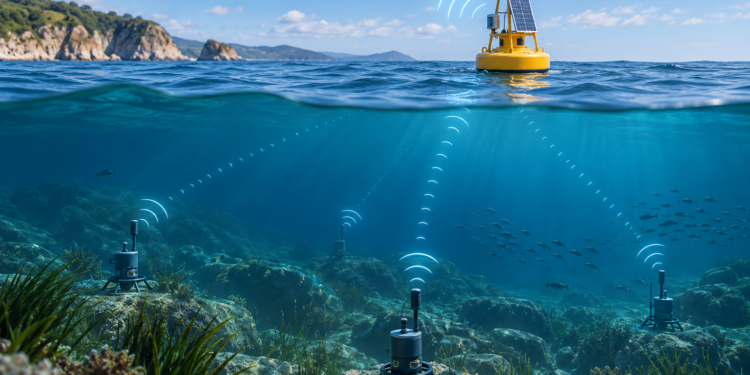
We are surrounded by connected devices. On land, sensors can continuously collect information and transmit it through wireless networks to cloud platforms where data can be analysed almost instantly.
Underwater, the situation is very different.
Conventional radio-based wireless technologies do not perform underwater as they do in air, making communication between submerged instruments considerably more complex. For decades, marine monitoring has therefore depended heavily on cables, autonomous data loggers and instruments that often need to be physically recovered before their information can be accessed.
An Italian deep-tech company is working to change that.
WSense, born from research at Sapienza University of Rome, develops wireless underwater communication technologies designed to connect submerged sensors, robotic platforms and surface systems. Its ambition is part of a broader technological concept known as the Internet of Underwater Things (IoUT).
From the Internet of Things to the Internet of Underwater Things
The principle is relatively simple: instead of treating each underwater sensor as an isolated instrument, multiple devices can become part of a network.
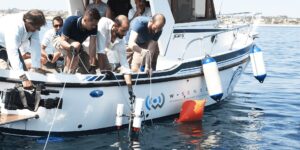
WSense describes its technology as a cableless end-to-end system connecting sensors to cloud applications. Its components enable secure multimodal wireless communication between submerged and surface sensing and robotic platforms.
In practical terms, underwater nodes can collect information from sensors and communicate through the network until those data reach a gateway and, ultimately, applications at the surface.
The technological challenge, however, is substantial. Radio waves used by conventional Wi-Fi are strongly attenuated underwater. WSense’s approach combines different communication technologies, including acoustic communication for longer underwater links and optical technologies where higher data rates can be achieved over shorter distances. Earlier descriptions of the technology also explain how network algorithms can adapt communication paths as marine conditions change.
The result is not simply an underwater sensor. It is an attempt to build the communication infrastructure that allows many different underwater sensors and platforms to become connected.
Aquaculture: from periodic measurements to continuous information
Aquaculture provides a good example of why underwater connectivity matters.
Water temperature, dissolved oxygen, salinity, currents, turbidity and other environmental parameters can directly influence animal welfare, farm management and production performance.
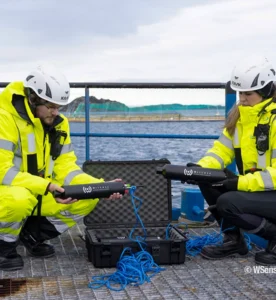
According to WSense, its aquaculture systems can connect sensors monitoring parameters including oxygen, temperature, CO₂, salinity, turbidity, chlorophyll, pH and ammonium. The technology can also be used for fish telemetry and for monitoring movement and structural stress in aquaculture cages. Importantly, the system is designed to work with sensors supplied by different manufacturers.
This potentially changes the role of environmental monitoring.
Rather than collecting measurements only during periodic field campaigns or retrieving instruments to access stored data, operators can receive information remotely and in real time.
For fish and shellfish farmers, such connectivity can support earlier identification of changing environmental conditions, provide information for farm management and create longer and more continuous datasets on the interaction between production sites and their surrounding ecosystems.
A real-world test in the Gulf of Follonica
One of the most interesting applications is already operating in Italian waters.
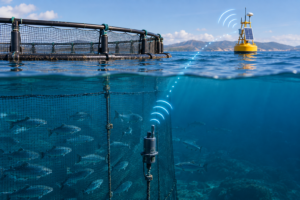
In 2025, a monitoring system commissioned by ISPRA (Italian Institute for Environmental Protection and Research) from WSense became operational in the Gulf of Follonica, on the Tuscan coast, under the PNRR-funded MER project.
The area hosts important fish and shellfish farming activities covering approximately 1,600 hectares. According to WSense, the underwater system transmits more than 1,500 real-time data points every day, monitoring water-quality parameters and underwater currents.
This is where the concept of an Internet of Underwater Things becomes tangible.
Sensors distributed through a marine production area no longer need to function simply as individual measuring instruments. They can become elements of a connected monitoring infrastructure capable of continuously feeding data into digital platforms.
For aquaculture, this could help connect environmental monitoring, farm management and ecosystem observation within the same digital environment.
Beyond aquaculture: giving marine ecosystems a digital voice
The implications extend well beyond fish farms.
WSense identifies environmental and biodiversity monitoring among the applications of its technology. Connected underwater sensors can measure water-column parameters, while other systems can integrate cameras, artificial-intelligence-based image recognition and underwater acoustic monitoring. Bidirectional communication can also allow parameters to be modified remotely from the cloud.
This creates interesting possibilities for marine protected areas, restoration projects, universities, NGOs and environmental agencies.
A coastal restoration project, for example, could potentially combine physical and chemical water measurements with biological observations. Researchers could receive continuous environmental information rather than relying exclusively on individual sampling campaigns. Marine managers could build longer time series to identify changes or anomalous events.
For projects operating in remote coastal areas, the ability to connect instruments without extensive underwater cabling could also make monitoring infrastructure more flexible.
The technology does not replace scientific sampling or field observation. Instead, its potential lies in creating a continuous flow of information between the underwater environment and the people responsible for studying or managing it.
From university research to the Blue Economy
WSense is also an interesting example of technology transfer from academic research into the Blue Economy.
The company’s origins are linked to the work of Professor Chiara Petrioli, Director of the Sensor Networks and Embedded Systems Laboratory (SENSES Lab) at Sapienza University of Rome. The laboratory identifies Petrioli as a pioneer in the Internet of Underwater Things and as CEO and founding partner of WSense.
University records show that Sapienza approved the creation of the WSense university spin-off in 2012. More recently, Sapienza approved the renewal of WSense’s status within its innovation ecosystem for the period from October 2024 to October 2027, highlighting the continuing technology-transfer relationship between the company and the university.
That trajectory is significant.
Many of the challenges facing the Blue Economy are not caused by a lack of sensors. Increasingly, the challenge is how to connect instruments, move data from the sea to decision-makers and transform measurements into information that can be acted upon.
What could a connected ocean mean for the Blue Economy?
The idea of connecting the ocean should not be understood simply as bringing “Wi-Fi underwater”.
Its real significance lies in making marine data more continuous, accessible and actionable.
For aquaculture operators, that could mean monitoring environmental conditions and farm infrastructure in real time. For researchers, it could mean longer and richer datasets. For environmental agencies and marine protected areas, connected networks could strengthen ecosystem observation. For offshore industries, similar technologies can support infrastructure monitoring and surveillance.
And for coastal communities and NGOs, particularly where environmental projects increasingly require measurable indicators and long-term monitoring, underwater connectivity could eventually provide new ways of documenting environmental change and evaluating the results of conservation and restoration interventions.
Connecting the Ocean: how WSense is building the underwater wireless internet