

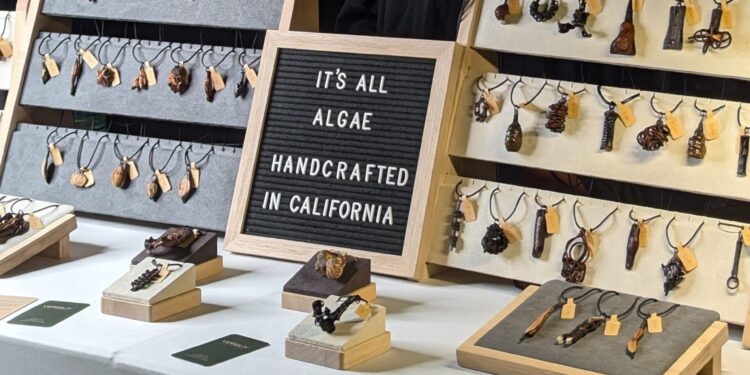
From Ocean Waste to Wearable Art: The Artist Giving seaweeds a Second Life – Let’s meet Versiliy, the skilled artist who creates these wonderful pieces using nothing but giant brown seaweed (kelp) found along California’s coastline.
His studies had nothing to do with manufacturing or working with kelp. Instead, he discovered that working with it was an intuitive, enjoyable activity—something he could do without feeling any pressure.
It all started when he was on a beach in Santa Monica and picked up a small piece of giant kelp. It looked alive, but it felt like a membrane, like plastic that nobody had manufactured.
For three years, he experimented with seaweed, exploring different ways to handle and shape it before showing any of his work to anyone.
The turning point came when he lost his office job. That same day, he decided to turn his passion into a creative project. As luck would have it, a festival was going to be held nearby, giving him time to prepare some of his work.
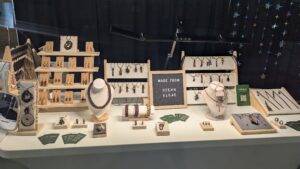
The Art of Experimentation: Learning from Every Piece
Transforming kelp into accessories is far more complex than simply collecting seaweed and letting it dry.
Each experiment can produce a different result, affecting the material’s shape, color, texture, and flexibility.
For Versiliy, careful documentation became one of the most valuable parts of the creative process.
By recording the details and outcomes of each attempt, he gradually developed a deeper understanding of how the material behaves and how to work with it.
So far, he has experimented with 18 species of seaweed found in California. Not all have proven suitable for his work, each for different reasons.
Today, he works with six different species of kelp, selected through 3 years of trial and experimentation.
His experience demonstrates how curiosity, patience, and careful observation can turn an unfamiliar natural material into a new creative medium.
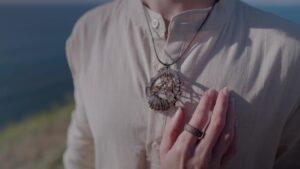
Sustainability Begins with the Way We Work
For Versiliy, sustainability is not an additional feature of his project. It is part of the process itself.
As he explains:
“It is in how the work is done, not something I add on top.”
Rather than harvesting kelp from the ocean, he collects only material that has already washed ashore, He does not cut kelp from living underwater forests.
This distinction matters. Kelp forests are important marine ecosystems, providing habitat and shelter for a wide range of species.
By working with washed-up material, Versiliy has developed a creative practice that does not require cutting living kelp for his designs.
His approach offers an example of how artistic innovation can begin with a closer look at the natural resources already available around us.
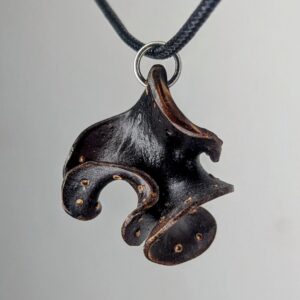
Turning Seaweed into Something Unexpected
Years of experimentation have helped Versiliy develop techniques that allow him to transform kelp in remarkable ways.
He can make the material more water-resistant, alter its volume, change its color without dyes, and control its flexibility, Even more remarkably, his creations are entirely handmade.
He does not rely on machinery. Instead, he has developed his own specialized tools to support the process, keeping their designs as part of his creative secrets.
But beyond the technical achievements, one of his greatest rewards comes from people’s reactions.
When visitors touch his creations, they often struggle to believe what they are holding.
Is it really seaweed?
For Versiliy, that moment of surprise is particularly meaningful.
“We are living through a new digital revolution, and it is hard to surprise anyone.”
Yet a material that has existed in the ocean for thousands of years can still leave people astonished.

From a Local Festival to Wider Recognition
For emerging artists, exhibitions and festivals can provide opportunities to introduce their work, connect with new audiences, and build meaningful relationships.
Versiliy’s first public presentation took place at the California Seaweed Festival in San Pedro, It marked the beginning of a new chapter, taking his work beyond private experimentation and into the public eye.
Since then, his creations have appeared on Good Day LA on FOX 11 and have been featured in Artist Closeup and ArtLo magazines.
His work also reached the Top 10 of The People’s Artist.
Alongside this growing recognition, Versiliy has developed partnerships with organizations and institutions including Kelp Ark, Algalita, and the Coastal and Marine Institute Laboratory at San Diego State University (SDSU).
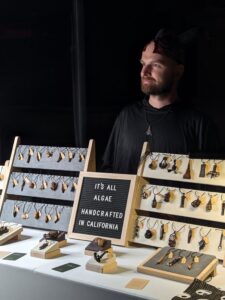
Beyond Jewelry: Exploring the Possibilities of Kelp
Jewelry was only the beginning.
Versiliy initially focused on accessories because their small size made them a practical starting point for experimenting with an unfamiliar material, But his ambitions extend far beyond wearable art.
He has already begun creating interior objects, including lamps, and hopes to explore larger forms in the future.
Interior design, costumes, and other creative applications are all possibilities he wants to investigate.
His curiosity also extends beyond California’s coastline, Versiliy hopes to experiment with other seaweed species, including Ecklonia maxima and Laminaria pallida from South Africa, as well as Laminaria ochroleuca and Saccorhiza polyschides, found near the Strait of Gibraltar.
For him, the possibilities are still unfolding.
The material that began as a small piece of seaweed on a beach may eventually find its way into entirely different forms of art and design.
The Ocean Still Has Stories to Tell
A piece of seaweed lying on a beach in Santa Monica might seem like the simplest beginning imaginable.
Yet that small discovery became the foundation of years of experimentation, artistic expression, and new possibilities for a natural material.
Humans have lived alongside seaweed for thousands of years. Still, people are amazed when they discover what it can become.
Versiliy’s story reminds us that innovation does not always require inventing something entirely new.
Sometimes, it begins by seeing something familiar in a completely different way.
There is so much left to discover, and a lot of it is lying at our feet.
From Ocean Waste to Wearable Art: The Artist Giving seaweeds a Second Life