


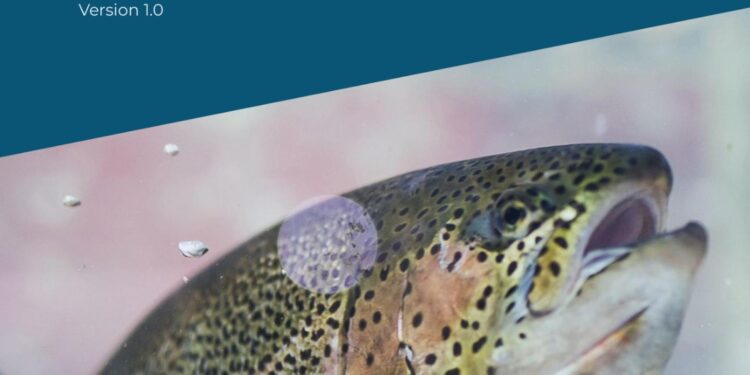
A new practical framework for rainbow trout welfare in seawater aquaculture – Fish welfare is becoming an increasingly important component of responsible aquaculture, alongside environmental sustainability, animal health and production efficiency. Yet, translating scientific knowledge on welfare into practical tools that can be routinely applied on farms remains a challenge. A newly published protocol from the Centre for Aquaculture Progress aims to address part of this gap for farmed rainbow trout (Oncorhynchus mykiss) during the ongrowing phase in seawater.
Published on 17 August 2026, the Rainbow Trout Operational Welfare Indicator (OWI) Protocol: Ongrowing, Seawater, Version 1.0 is presented by its authors as the first comprehensive Operational Welfare Indicator tool specifically developed for assessing farmed rainbow trout in seawater systems. The protocol combines scientific evidence with practical scoring guidance intended for farm personnel, certification bodies, auditors and buyers.
From scientific evidence to practical monitoring
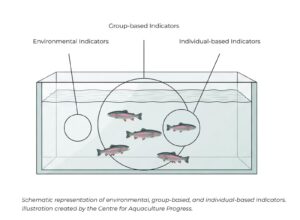
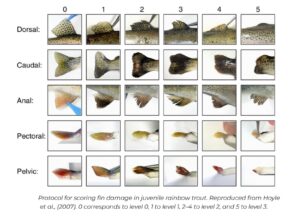
The protocol is built around 33 Operational Welfare Indicators, divided into three categories: 14 individual-based indicators, five group-based indicators and 14 environmental indicators. Together, these cover physical condition, behavior, mortality and the environmental conditions experienced by the fish.
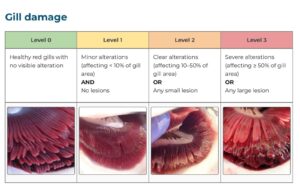
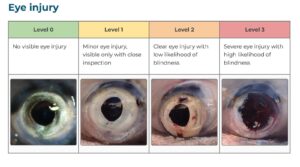
Individual-based indicators include characteristics such as body condition, wounds, skin and fin damage, eye condition, gill damage, vertebral deformities and sea lice. Group-based indicators address mortality and behavioral patterns, including feeding, swimming, aggressive and aberrant behavior. Environmental indicators include parameters such as stocking density, dissolved oxygen, temperature, pH, ammonia, water velocity and salinity.
Each indicator is assessed using a four-level scoring system, from 0 to 3. In general, level 0 represents an optimal condition, while increasing scores indicate progressively greater deviations or welfare risk. Importantly, the protocol emphasizes that these scores should not be interpreted as direct measurements of the fish’s subjective welfare. Instead, they represent indicators of the likelihood of welfare compromise and are most informative when several indicators are considered together and followed over time.
This distinction is important because fish welfare is multidimensional. A single observation cannot adequately describe an animal’s overall welfare, and environmental conditions may interact with health, behavior and individual history. The protocol therefore encourages a combined and longitudinal interpretation rather than relying on isolated scores.
A transparent evidence-based approach
One of the notable features of the protocol is its explicit consideration of the strength of the scientific evidence supporting each indicator. The authors reviewed existing welfare frameworks, industry materials and certification requirements, while considering scientific validity, practical feasibility, commercial relevance and species-specific welfare relevance. Thresholds were developed through indicator-specific reviews of the available literature, prioritizing evidence from rainbow trout in commercial seawater conditions where available.
However, the protocol does not present the evidence base as equally strong for all indicators. For example, rainbow-trout-specific evidence is rated as high for fin damage, stocking density and dissolved oxygen, while several other indicators have low or very low levels of species-specific evidence. Some thresholds also rely partly on evidence from Atlantic salmon or other production contexts where direct rainbow trout evidence is limited.
This transparency is valuable because it highlights both what is currently known and where further research is needed. Rather than presenting the protocol as a definitive endpoint, the Centre for Aquaculture Progress describes it as a living document that will be reviewed and updated as scientific knowledge and farming practices evolve.
A contribution to sustainable aquaculture
The development of standardized welfare monitoring tools is particularly relevant as aquaculture seeks to strengthen its environmental, social and animal-welfare performance. By providing a common framework for observing fish condition, behavior and environmental conditions, the protocol can help connect welfare monitoring with everyday farm management.
The Centre for Aquaculture Progress also positions the protocol as complementary to, rather than a replacement for legislation, certification schemes and broader welfare requirements. Its stated aim is to provide a practical monitoring foundation that can support both farm-level decision-making and compliance-related processes.
Ultimately, the value of such a framework will depend on its implementation in real farming conditions, the consistency of assessment between observers, and the continued development of species-specific scientific evidence. The protocol itself acknowledges limitations including sampling challenges, assessor subjectivity, the snapshot nature of periodic assessments and variability in the evidence supporting individual indicators.
For rainbow trout producers operating in seawater, however, the new protocol represents an important step toward more systematic and evidence-informed welfare monitoring. More broadly, it illustrates how scientific knowledge can be translated into practical tools that support both animal welfare and the development of a more responsible and sustainable aquaculture sector.
Source: Centre for Aquaculture Progress. (2026). Rainbow Trout Operational Welfare Indicator (OWI)
Protocol: Ongrowing, Seawater (Version 1.0). https://doi.org/10.5281/zenodo.21869741
A new practical framework for rainbow trout welfare in seawater aquaculture