



Beyond the numbers: what is the invisible oxygen challenge inside marine fish farming cages? Dissolved oxygen is essential for fish health, welfare and performance. Yet knowing the average oxygen concentration around a sea cage may not tell the whole story.
This is the question explored by Dimitrios Pafras, a marine biologist and fisheries scientist whose work connects marine ecology, aquaculture, fish health and sustainable management of marine ecosystems.
Dimitrios is currently a PhD candidate at the University of Thessaly, where his doctoral research focuses on the ecology, population biology and sustainable management of the pearl oyster Pinctada radiata in the South Evoikos Gulf. Alongside his research, he has gained direct experience in commercial aquaculture, including production and feeding management at AVRAMAR. He currently works as Head of Fish Pathology and Quality Control at LEMOND CO. S.A., bringing together research, fish health and practical aquaculture experience.
It is this combination of scientific and practical perspectives that makes his interest in the environmental conditions inside aquaculture cages particularly relevant.
What oxygen are the fish actually experiencing?
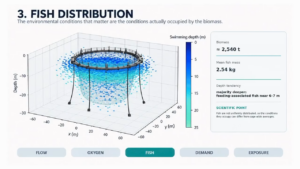
Fish inside a sea cage are not living in a static environment.
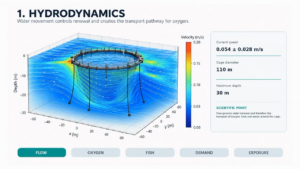
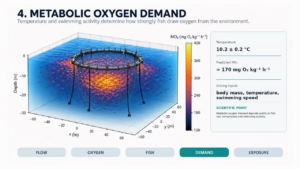
Water is constantly moving through the cage, oxygen conditions can vary spatially, fish are not distributed uniformly, and temperature influences their metabolic demand.
As you read this article, let the graphics guide you through the key concepts.
So instead of asking only:
“What is the average dissolved oxygen concentration?”
Dimitrios’s work raises another question:
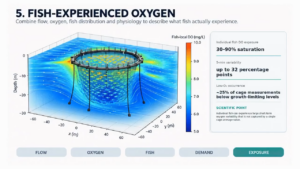
“What oxygen conditions are the fish actually experiencing?”
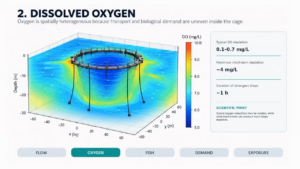
His conceptual framework brings these processes together:
Hydrodynamics → Dissolved oxygen → Fish distribution → Metabolic demand → Fish-experienced oxygen
From the water to the fish
The idea is straightforward: an oxygen measurement taken within or around a cage does not necessarily represent the conditions experienced by every fish.
Hydrodynamics influence how water and oxygen move through the cage. Fish distribution determines where individuals spend their time, while temperature and metabolic demand influence their oxygen requirements.
Looking at these processes together therefore provides a different perspective—one that considers the environment from the point of view of the fish.
Building the picture from existing research
Dimitrios’s framework is based on a literature-based synthesis of published research on Atlantic salmon (Salmo salar) in sea cages, bringing together knowledge on hydrodynamics, dissolved oxygen, fish distribution, temperature and metabolic demand.
His broader research interests also extend to marine biodiversity, fisheries ecology, aquaculture sustainability, climate-related pressures and the use of Earth Observation, artificial intelligence and quantitative approaches in marine research.
His current work on dissolved oxygen conditions within marine aquaculture sea cages remains ongoing and has not yet been published. For this reason, the focus at this stage is on the broader scientific question and conceptual framework rather than unpublished results or datasets.
Why does this matter for aquaculture?
For sustainable aquaculture, the question is not simply whether oxygen levels are “good” or “bad.”
It is about understanding how the physical environment and fish biology interact inside the cage.
A better understanding of fish-experienced oxygen could contribute to more informed approaches to fish welfare, environmental monitoring and aquaculture management, while helping researchers and producers better understand the conditions under which farmed fish live.
Dimitrios’s approach reflects a broader idea in modern marine science: environmental data become more meaningful when we connect them to the organisms experiencing those conditions.
And perhaps that brings us back to the question with which we started:
How much oxygen is in the cage?
Maybe the more important questions are:
What oxygen are the fish actually experiencing?
Beyond the numbers: what is the invisible oxygen challenge inside marine fish farming cages?
In Dimitris’ next article, we will provide further insights into this topic.