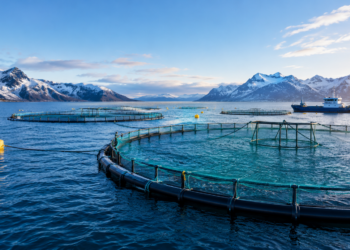



The Sea Urchin Paradox: too many in Norway, too few in the Mediterranean Sea – Nature depends on balance. Nowhere is this more evident than in the ocean, where every species is part of a complex food web and each trophic level helps regulate the next. Predators, herbivores and primary producers are connected in ways that can keep an ecosystem stable or transform it when one of those relationships is disrupted.
Sea urchins offer a remarkable example. As key marine grazers, their abundance can shape entire underwater landscapes. Too many can contribute to the disappearance of algal forests; too few can signal a profoundly altered ecosystem. The same animal can therefore become a symbol of two opposite ecological crises.
Norway: when too many sea urchins turn forests into deserts
Along the coast of Northern Norway, something extraordinary is happening beneath the surface.
Between April 2024 and May 2026, Rissa Citizen Science organised 23 kelp restoration events at Sørsjetéen, Telegrafbukta and Øksfjord. Nearly 500 volunteers took part, removing 98,085 sea urchins from the seabed.
The objective was not to eradicate sea urchins. It was to give underwater forests a chance to return.
Large areas of Norway’s once-productive kelp forests were transformed decades ago into what marine ecologists call urchin barrens: underwater landscapes where extremely high densities of sea urchins graze so intensively that kelp forests struggle to survive.
The Norwegian Institute for Water Research (NIVA) estimates that around 8,400 square kilometres of kelp forest were lost in Norway following one of the largest sea urchin overgrazing events ever recorded in the north-east Atlantic.

But blaming the sea urchins alone would miss the most important part of the story.
The green sea urchin (Strongylocentrotus droebachiensis) is a natural component of the Norwegian marine ecosystem. The problem emerged when the ecological relationships around it changed.
The decline of predators that once helped control sea urchin populations allowed their numbers to explode. With insufficient predation, grazing pressure became overwhelming and productive kelp forests shifted towards barren seafloors.
In other words, the sea urchins were not the original problem. The loss of balance was.
This is what makes the work of Rissa Citizen Science particularly interesting. Volunteers are effectively helping to restore that balance by temporarily reducing urchin densities.
And nature is responding.
At the restoration sites, kelp and other seaweeds are returning. Rissa reports recovering underwater forests that are once again providing nursery habitat for fish and supporting marine biodiversity.
It seems like a straightforward conservation story: too many sea urchins, remove some of them, allow the forest to return.
Until we travel south.
Puglia: when there are too few
Move from the cold waters of Northern Norway to the warm Mediterranean coast of Puglia, in southern Italy, and the story appears to turn upside down.
Here, the problem is not an abundance of sea urchins.
It is their disappearance.
The protagonist is a different species: the purple sea urchin, Paracentrotus lividus, one of the most recognisable inhabitants of Mediterranean rocky shores, and a highly prized delicacy in southern European cuisine.
Demand has come at a cost.
A major scientific study published in Scientific Reports examined P. lividus populations across the Mediterranean and conducted field surveys in Puglia and Sicily in 2023. Researchers recorded an average density of just 0.2 individuals per square metre, among the lowest values ever reported in the areas studied.
In Puglia, only 6% of the sampled sea urchins were of commercial size, raising concerns about the population’s reproductive potential.
The researchers concluded that the Mediterranean decline is not driven by a single cause. Overharvesting interacts with increasingly warm seas, extreme climatic events and other ecological pressures. Their meta-analysis indicates that P. lividus populations have been declining across the Mediterranean for roughly two decades.
Puglia had already reacted.
Regional Law No. 6 of 2023 introduced a three-year ban on harvesting Paracentrotus lividus to allow depleted populations to recover. In 2026, rather than ending the moratorium, the regional authorities extended the protection until 30 June 2029, alongside scientific monitoring and plans for a more sustainable management system.

The new legislation even provides for restocking through the release of post-larval sea urchins.
There is an ecological reason why the disappearance matters beyond the future of a traditional fishery.
Paracentrotus lividus is not simply seafood. Scientists describe it as a key herbivore in Mediterranean shallow-water ecosystems, where its grazing helps shape benthic algal communities and influences the dynamics of rocky reefs and Posidonia oceanica habitats.
But here, too, the story is more complicated than saying that sea urchins are “good for the ecosystem.”
At very high densities, Mediterranean sea urchins can overgraze macroalgal forests and help create barren grounds; remarkably similar to what happens in Norway. At very low densities, however, the disappearance of an important native grazer represents another profound alteration of the food web.
The ecological objective, therefore, cannot simply be to have more sea urchins.
Nor can it be to have fewer.
It is to restore functioning populations within functioning ecosystems.
Restoring balance
The sea urchin paradox reminds us that conservation is not about having more or fewer of a species, but about restoring the relationships that keep an ecosystem in balance.
In Puglia, conservation measures and, perhaps one day, carefully planned restocking could help sea urchin populations recover and regain their ecological role. In Norway, scientists and volunteers can continue giving kelp forests the space they need to return.
Two opposite interventions, but one shared goal: helping marine ecosystems recover their balance and, ultimately, their ability to sustain it on their own.
The Sea Urchin Paradox: too many in Norway, too few in the Mediterranean Sea