



Ahmed Nabil Is Driving Marine Innovation and Restoration Efforts to Protect the Arab World’s Coral Reefs
In the Arabian Gulf, where rising sea temperatures and increasing salinity test the limits of marine resilience, one man is redefining the future of coral restoration. Ahmed Nabil — a PADI Master Scuba Diving Trainer, IUCN SSC Coral Specialist Group Member, and UNESCO Ocean Decade ECOP Member — has dedicated his career to merging diving, science, and innovation to protect fragile reef ecosystems.
As the founder of the ARAB World Node under the UNESCO Ocean Decade ECOP Programme (currently under development), and leader of Alpha Environmental Education and Studies and Alpha Diving, Ahmed’s mission is clear: to develop sustainable, nature-based solutions that enhance coral growth, biodiversity, and climate resilience across the region.
Through his groundbreaking collaboration with the Fujairah Research Center, his pioneering In Situ Coral Reef Natural Sustainability Model — a technique integrating natural materials and scientific design — has been recognized and presented at the IUCN World Conservation Congress, marking it as a global exemplar for coral restoration.
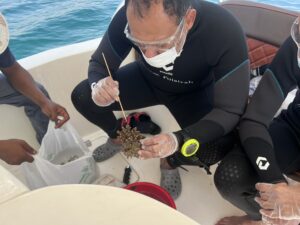
A Journey Beneath the Surface
Ahmed’s path into marine conservation began not in a research lab, but underwater. As a professional diver, he witnessed firsthand the ocean’s gradual decline — reefs losing color, corals bleaching, and marine life diminishing in areas that once thrived with vitality.
“It became impossible to ignore the mounting pressures — acidifying oceans, plastic pollution, and habitat loss. These were not distant scientific terms; they were realities I saw during every dive.”
What started as a passion for exploration evolved into a calling for preservation. Ahmed realized that the diving industry — which connects millions of people to the ocean — also carries a profound responsibility to protect it. Merging his diving expertise with marine science, he transformed his career from exploration to active conservation, developing field-based solutions that rebuild ecosystems while aligning tourism and development with sustainability.
Integrating Science, Training, and Measurable Impact
Ahmed’s dual roles as a PADI Master Scuba Diving Trainer and IUCN SSC Coral Specialist Group Member have shaped a unique, integrated approach to marine restoration and education. His experience in the diving industry instilled discipline, safety, and environmental awareness — principles that now form the backbone of his restoration methodologies.
“From diving, I learned structure and precision. From science, I learned to ask questions. Combining both gave me a model that is practical, safe, and measurable.”
Building on this synergy, Ahmed designed the first UNESCO Ocean Decade–endorsed and PADI-accredited Marine Conservation Program, a step-by-step, in-situ framework for divers and early-career professionals. Participants move through all stages of conservation: studying marine ecosystems, assessing degradation, identifying causes, and applying restoration techniques — all underpinned by data-driven monitoring and evaluation.
The result is not only restored reefs but empowered people — a new generation of ocean stewards capable of translating science into tangible environmental outcomes.

Redefining Coral Restoration Through Nature-Inspired Innovation
What sets Ahmed’s coral restoration project apart is its commitment to nature-based, sustainable design. Using 100% natural materials — oyster shells, palm fronds, mountain rocks, and natural clays — the project minimizes ecological impact while maximizing biological compatibility.
Its modular design allows for scalable deployment by small teams, making restoration efficient and accessible. Beyond structure, the initiative focuses on ecosystem-level recovery, incorporating species like micro-crabs and echinoderms to naturally balance algae and biofouling.
“We’re not just growing corals; we’re rebuilding ecosystems,” Ahmed explains. “Each site is a living, self-sustaining community.”
By integrating industrial project management standards — from risk assessments to progress tracking — Ahmed ensures that restoration is not only innovative but accountable, measurable, and replicable.
Overcoming Environmental and Structural Challenges
Ahmed explains that coral restoration in the Arabian Gulf presents a unique set of challenges, unlike those in most tropical regions. “The Gulf is defined by extreme summer sea temperatures, high salinity, and limited water circulation,” he says.
“These conditions place immense stress not only on marine life but also on the restoration teams and equipment working in the field. Such environmental extremes truly test both the resilience of corals and the durability of restoration methods.”
He further highlights a broader issue extending beyond regional boundaries — the gap between academic research and practical field application. “While universities are producing strong scientific knowledge, much of it remains confined to papers and laboratories. There is often limited translation of that science into hands-on, operational restoration practices.
Ahmed notes.
“Bridging this gap is essential to ensure that conservation outcomes are both scientifically sound and effective in the field.”
Another challenge he identifies is the shortage of systematic training and capacity-building programs for divers who want to engage in conservation projects. “Many divers are passionate and willing to help, but they lack the technical training to collect data, assess reef health, or participate safely in restoration work,” he explains. “This need was one of the main motivations behind developing structured training programs designed to prepare divers and early-career professionals for real-world conservation roles.”
Ahmed adds that, like most marine conservation efforts globally, projects in the Arabian Gulf face universal challenges — from securing sustainable funding and obtaining environmental permits to managing unpredictable sea conditions.
He concludes
“Overcoming these barriers requires ongoing collaboration between institutions, regulators, and the private sector to build a resilient, long-term model for coral restoration in the region.”
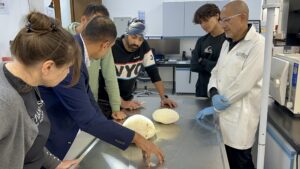
Empowering Local Communities and Divers as Ocean Stewards
Community engagement lies at the heart of Ahmed’s work. Through Alpha Diving and the Marine Conservation Program, local divers, students, and professionals gain hands-on experience in coral restoration, monitoring, and data collection.
Outreach programs — from school workshops to coastal cleanups — aim to build environmental awareness and community pride in marine heritage.
“Restoration succeeds when it becomes everyone’s responsibility. We’re building a culture, not just a program.”
This inclusive model ensures that coral restoration projects continue beyond funding cycles — sustained by local knowledge, commitment, and ownership.
The Next Generation of Ocean Leaders
Ahmed believes that youth and early-career scientists hold a pivotal role in shaping the future of marine conservation across the Arab region. The environmental challenges facing our coasts — from coral reef degradation to climate-driven ecosystem shifts — demand fresh ideas, innovation, and cross-disciplinary collaboration. These are precisely the strengths that young professionals bring to the field.
He explains that one of the region’s persistent gaps lies in the lack of opportunities for applied, hands-on field experience.
“Many young researchers have solid academic foundations but limited access to structured programs that bridge scientific knowledge with practical restoration work,” Ahmed says. “That was one of the key motivations behind developing our Marine Conservation Program — to provide experiential, step-by-step training that connects theory with implementation, and data with action.”
Through initiatives like the ECOP Web Platform – Arab World Node, currently being developed under the UN Ocean Decade framework, Ahmed and his team aim to build a regional hub for capacity building, collaboration, and knowledge exchange. Their goal is to empower youth to become active participants in restoration, policy design, and innovation.
“By investing in their training, mentorship, and inclusion,” Ahmed emphasizes
“we are not only preparing the next generation of conservation leaders but also ensuring that marine stewardship in the Arab world is locally driven, scientifically grounded, and globally connected.”
Bridging Education, Diving, and Science for Ocean Literacy
Ahmed emphasizes that educational institutions and diving organizations share a vital responsibility in advancing ocean literacy and citizen science. “The ocean cannot be protected by science alone,” he says. “It requires informed communities, skilled professionals, and accessible opportunities for people to get involved.”
He believes that academic institutions must integrate marine science into practical, field-based learning — giving students direct exposure to ecosystems, data collection, and restoration methods. “This hands-on approach transforms theoretical knowledge into real-world skills,” he explains, “empowering students to actively contribute to national and regional conservation goals.”
At the same time, he highlights the crucial role of diving organizations. “Divers are the ocean’s frontline observers — they witness changes as they happen,” Ahmed notes. “By offering structured conservation training, standardized data collection, and citizen science modules, the diving industry can turn recreational divers into key contributors to marine monitoring and restoration.”
Through the UNESCO Ocean Decade–endorsed and PADI-accredited Marine Conservation Program, Ahmed and his team have shown how collaboration between academia, diving, and conservation can create a 360-degree educational model — one that connects science, industry, and community.
“By uniting these sectors,” he concludes, “we can build a culture where every dive becomes a data point, every student becomes a marine steward, and ocean literacy becomes a shared societal value rather than a specialized discipline.”
Vision for the Region’s Blue Economy
Looking ahead, Ahmed envisions a science-driven, inclusive blue economy in the GCC — one that harmonizes marine conservation, innovation, and economic development.
“Our region can lead the world by example — balancing growth with stewardship and turning environmental challenges into opportunities.”
By investing in youth, promoting ocean literacy, and fostering collaboration across sectors, he believes the Arab world can become a global model for sustainable marine development.
Advice for the next generation
“It all starts with education. Regardless of what you are striving to build or achieve — a career, a family, or a nation — the foundation is always education. The first step in any learning journey is awareness. Once that begins, there should be no ceiling to continuous growth and improvement.
You don’t need to be a scientist or a professional diver to make a difference. Every individual can contribute by becoming informed, making responsible choices, and supporting initiatives that protect our marine environment. The ocean connects us all — and when we invest in education and awareness, we invest in a sustainable future for ourselves and for generations to come.”
Ahmed Nabil Is Driving Marine Innovation and Restoration Efforts to Protect the Arab World’s Coral Reef.