


When borders become bridges: Namibia and South Africa turn a shared vision for the ocean into action –
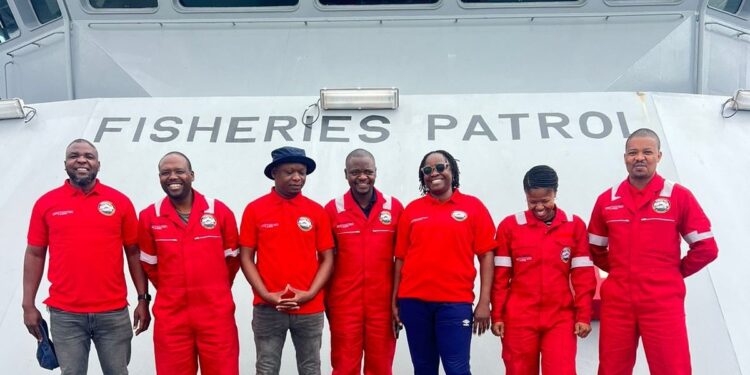
The 25-day operation, conducted from 5 to 30 September, brought fisheries enforcement officials from both countries together aboard Namibia’s patrol vessel Anna Kakurukaze Mungunda, operating across their Exclusive Economic Zones. South African officers also worked from Namibia’s Fisheries Monitoring Centre, sharing intelligence, monitoring vessel movements and providing real-time operational information.
Yet the significance of the operation reaches far beyond a single patrol.
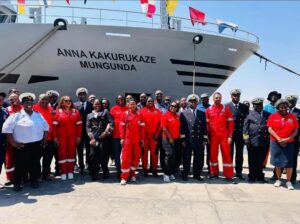
From agreement to action
The mission represents the practical implementation of the 2019 Memorandum of Understanding on cooperation in fisheries and aquaculture between Namibia and South Africa.
The agreement established a framework for cooperation in fisheries management, aquaculture, research, marine resource management and Monitoring, Control and Surveillance (MCS). Since then, technical cooperation has strengthened information sharing, joint procedures, training and coordinated enforcement.
The September patrol marks an important transition: from political commitment to operational cooperation at sea.
For Blue Life Hub, this is a powerful example of what effective ocean governance can look like when neighbouring States share not only objectives, but also knowledge, capacity and responsibility.
At the closing ceremony in Walvis Bay, Marisa Kashorte described precisely this transition from commitments to implementation:
“Over the last few years, both countries have moved decisively from policy commitments to practical implementation.”
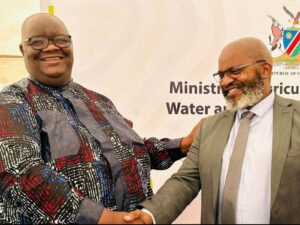
One ecosystem, a shared responsibility
Namibia and South Africa share the Benguela Current Large Marine Ecosystem, and with it migrating fish stocks, ecological processes, economic opportunities and coastal communities whose livelihoods depend on healthy marine resources.
Speaking at the official closing event on behalf of the South African Government, Marisa Kashorte of South Africa’s Department of Forestry, Fisheries and the Environment highlighted the importance of partnership, trust and a shared vision for the sustainable management and protection of ocean resources.
Her message strongly resonates with the vision of Blue Life Hub: marine ecosystems connect countries. Environmental pressures and fish stocks do not stop at national borders, and their protection increasingly requires cooperation across jurisdictions.
The Namibia-South Africa initiative shows how a maritime boundary can therefore become a platform for cooperation rather than simply a dividing line.
As Kashorte put it in one of the central messages of her closing remarks:
“This operation has demonstrated that our maritime boundaries do not divide us. Rather, they connect us through a shared responsibility to protect the Benguela ecosystem and the valuable marine resources upon which so many livelihoods depend.”
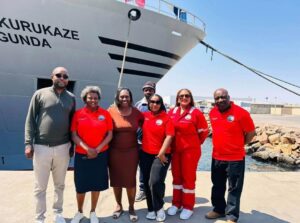
Protecting the ocean, supporting communities
The fight against IUU fishing is not only an enforcement issue. It is also about protecting food security, legitimate economic activity, coastal livelihoods and the long-term resilience of marine ecosystems.
This connection between environmental protection and socioeconomic wellbeing is fundamental to a sustainable blue economy.
By combining surveillance, intelligence sharing, capacity building and coordinated action, the joint patrol demonstrates how protecting marine resources can also safeguard the benefits those resources generate for coastal communities.
A model for other regions
Perhaps the strongest value of this initiative is its potential as a replicable model.
Many of the greatest challenges facing the ocean, from IUU fishing and biodiversity loss to climate change and the sustainable management of migratory resources, cannot be effectively addressed by individual States acting alone.
Namibia and South Africa offer a practical pathway: establish a common political commitment, create a formal framework between States, develop technical mechanisms for cooperation and ultimately act together at sea.
Importantly, this is not intended to be a one-off operation. The countries have agreed to make the joint patrol an annual exercise, with South Africa expected to host the next mission in 2027 and the two countries rotating maritime assets.
Continuity can turn a successful bilateral operation into a lasting model of regional ocean governance.
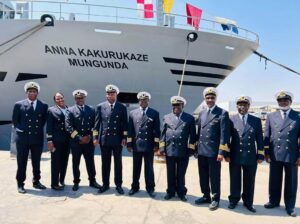
From shared waters to shared vision
At Blue Life Hub, we believe this experience carries a message that extends well beyond Namibia and South Africa:
Shared ecosystems need shared visions. Shared visions need agreements. And agreements reach their true potential when trust, knowledge and cooperation turn them into action.
This first bilateral patrol demonstrates precisely that progression, from diplomacy to technical cooperation, and from cooperation to people working side by side at sea.
Blue Life Hub congratulates the Namibian and South African authorities and all the fisheries control officers, monitoring teams, vessel crews and technical personnel who made the operation possible.
We extend a special thank you to Marisa Kashorte and the South African Department of Forestry, Fisheries and the Environment for bringing the South African Government’s perspective to the official closing event and for highlighting the importance of trust, partnership and shared responsibility in protecting our ocean.
Her closing words also place this first operation within a longer horizon:
“Today’s ceremony marks the end of a voyage. But it is also the beginning of a new chapter.”
A chapter, as she described it, built on stronger partnerships, improved operational cooperation, greater information sharing and trust — with a shared determination to ensure that future generations inherit healthy oceans, sustainable fisheries and secure maritime spaces.
When countries share an ecosystem, cooperation is more than an opportunity. It is a foundation for protecting together, growing together and building a sustainable blue transformation.
For our more curious readers, one final detail worth remembering: the Anna Kakurukaze Mungunda, in service since 2004, is named after a Namibian heroine, a solemnly fitting name for a vessel whose mission reminds us that protecting the ocean from illegal fishing also calls for courage.
When borders become bridges: Namibia and South Africa turn a shared vision for the ocean into action