


Beyond Oxygen: What happens when fish face Hypoxia? –
In our previous Blue Life Hub article, “Beyond the Numbers: The Invisible Oxygen Challenge Inside Sea Fish Cages,” developed from our conversation with Dimitris Pafras, we asked a simple but important question: What oxygen do fish actually experience inside a sea cage? But knowing the oxygen level is only the beginning.
A recent review by Marina Linhares Azevedo, Ivar Rønnestad, Trygve Sigholt and Malthe Hvas takes us one step further, exploring what happens inside the fish when oxygen becomes limited , and what this means for the future of aquaculture.

When oxygen becomes a challenge
For fish, oxygen is not simply a number displayed on a sensor.
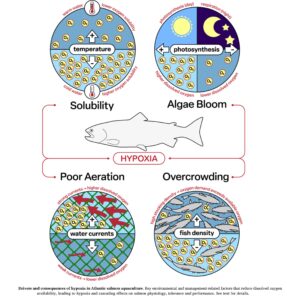
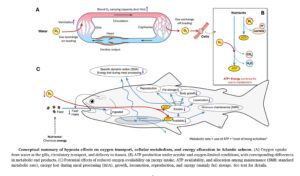
When dissolved oxygen decreases, fish begin to adjust. Their respiration, circulation, metabolism, behaviour and energy use can all change. They may reduce feeding and growth, alter their behaviour or avoid areas with low oxygen when possible.
The response also depends on how low the oxygen is, how long the exposure lasts, the temperature, the size and life stage of the fish, and other environmental conditions.
So there is no single number that tells the whole story.
A short period of low oxygen is not necessarily equivalent to prolonged or repeated exposure.
The fish can adapt – but only up to a point
Fish have sophisticated mechanisms that help them cope with changing oxygen conditions.
At the cellular level, pathways such as the hypoxia-inducible factor (HIF) system help regulate the response to low oxygen. Fish can also adjust their metabolism and behaviour to maintain their functions under changing conditions.
But adaptation has limits.
When hypoxia becomes too severe or lasts too long, these mechanisms may no longer be sufficient. Physiological performance can decline, affecting feeding, growth, health and welfare.
And not all fish respond in the same way.
Life stage matters.
Early developmental stages can be particularly vulnerable, while later stages may show different physiological and behavioural responses. Individual differences in tolerance and adaptation are also an important area of ongoing research.
From reacting to predicting
This is where the story becomes particularly interesting for aquaculture.
If oxygen conditions can change rapidly, simply measuring oxygen after a problem occurs is not enough.
The next step is to move from monitoring to anticipation.
Real-time sensors can tell us what is happening in the water. Biological knowledge can help us understand what those conditions mean for the fish. Predictive models can potentially help us anticipate periods of increased risk.
Emerging approaches such as digital twins could eventually bring these different sources of information together, helping farmers better understand and manage changing environmental conditions.
The goal is not simply to collect more data.
It is to turn data into understanding, prediction and better decisions.
Why this matters for the future of aquaculture
Climate change makes this challenge even more relevant.
Warming waters, changing stratification, harmful algal blooms and other environmental changes can influence oxygen availability and interact with the physiological demands of farmed fish.
This means that the future of oxygen management will require more than defining a fixed “safe” value.
We need to understand:
- When does oxygen become a problem?
- For which fish?
- For how long?
- And can we predict the risk before it affects them?
These questions are helping move aquaculture toward a more proactive approach, combining environmental monitoring, fish physiology, welfare and predictive management.
Our previous article showed that oxygen inside a cage is more than a number.
This new research helps explain why.
And perhaps the most important shift for the future is moving from simply asking “How much oxygen is there?” to asking: “What does that oxygen mean for the fish – and what can we do before it becomes a problem?”
Scientific reference
Azevedo, M.L., Rønnestad, I., Sigholt, T. & Hvas, M. (2026). Hypoxia in Atlantic salmon aquaculture: Current understanding and the way forward toward mitigation and predictive management. Aquaculture Reports, 49, 103739. https://doi.org/10.1016/j.aqrep.2026.103739.
Beyond Oxygen: What happens when fish face Hypoxia?