


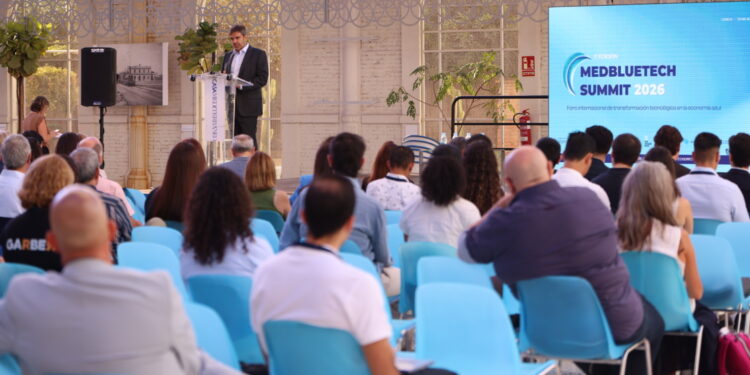
MedBlueTech Summit 2026: Ocean Data, Digital Transformation and Blue Innovation in the Mediterranean – Alicante, 1 October 2026. Ocean data, digital transformation and applied innovation took centre stage at the second edition of MedBlueTech Summit, held at Casa Mediterráneo in Alicante and promoted by Mediterranean Algae.
The event brought together more than 100 representatives from companies, public administrations, research centres, financial institutions and organisations linked to the blue economy to discuss how digitalisation and data are transforming the management of marine-related activities, from ports and marinas to aquaculture, and how these advances can be translated into market-ready solutions.
The discussions were particularly timely following a summer marked by record temperatures in Mediterranean waters and prolonged marine heatwaves. This changing environmental scenario poses new challenges for coastal industries and reinforces the need for businesses, the scientific community and institutions to strengthen their monitoring, adaptation and response capacities.
From ocean data to actionable knowledge
The generation, availability and governance of ocean data emerged as one of the central themes of the Summit.
Patrick Gorringe, from EMODnet, presented the European perspective on ocean observation and marine environmental data, showing how Europe is moving towards a model that integrates ocean observation, new technologies, data services and applications. Within this framework, Horizon Europe is mobilising €92 million to strengthen ocean observation and the development of marine technologies and data flows.
The discussion also addressed what happens once this information becomes available and how it can be transformed into useful knowledge.

During the Green & Digital Ports session, Francisco Toledo, from the Smart Ports Chair, highlighted the importance of opening up collaboration around ocean data so that the ecosystem can develop solutions tailored to real environmental needs. Josep Sanz, from Fundación Valenciaport, focused on data governance as one of the challenges that must accompany the digitalisation process.
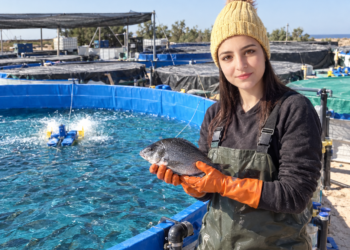
The relevance of data extends across other sectors of the blue economy. During the session dedicated to aquaculture, Eloy Meseguer, from Global Aquaculture, highlighted the value of data for business decision-making, both when prioritising investments and when scaling solutions.
From the marina sector, Jordi Caballé, from Marinas de España, stressed the need to move from water-quality sensing towards environmental management policies capable of scaling and standardising these processes. Such an approach would enable marinas to measure and demonstrate, through data, their commitment to the marine environment in which they operate.
Continuous monitoring for ports and marinas
Applied technology and measurable environmental impact were another key focus of the Summit.
Mediterranean Algae is deploying more than 30 POSINODE® stations across mainland Spain and the Balearic Islands, with an expected capacity to generate around 5.6 million ocean data points per year. The stations continuously monitor water quality and its evolution, helping to expand knowledge of aquatic environments and paving the way for environmental prediction tools capable of anticipating critical events along Mediterranean coasts.
The company’s work in bioremediation was also presented through MEDALG, introduced by Silvia Antón, COO of Mediterranean Algae, during a session dedicated to algae-based bioremediation for sustainable aquaculture.
Through Bioremed Algae, Mediterranean Algae has recorded 50.2 million litres of regenerated port water and a net emissions reduction of 173.5 kg CO₂e, including 54.9 kg CO₂e associated with potentially avoided N₂O emissions.
As Yago Sierras, CEO of Mediterranean Algae and Director of MedBlueTech Summit, stated:
“MedBlueTech demonstrates that when we connect business, knowledge, public administration and investment around real Mediterranean challenges, the blue economy stops being a concept and becomes projects, jobs and applied innovation. The great value of this initiative has been to build an ecosystem capable of accelerating solutions that are born here and can have a global impact.”
Sierras also highlighted the company’s recent development, noting that Mediterranean Algae has mobilised more than €3 million in capital, created 26 jobs and involved more than 300 organisations over the past twelve months.
The regional perspective was provided by Eduardo Pascual, Regional Secretary for Innovation, who underlined the need to combine technological transformation with environmental sustainability. He noted that the regional government has allocated approximately €2.7 million to R&D&I projects aimed at strengthening the sector.
“Technology is not only a driver of efficiency: it is our main ally in guaranteeing the health of our seas,” Pascual said.
Connecting Mediterranean knowledge, technology and markets
Beyond technological development, MedBlueTech Summit placed strong emphasis on building an ecosystem capable of connecting scientific knowledge with companies, institutions and investment.
The Summit was organised by Mediterranean Algae in collaboration with Casa Mediterráneo, the Alicante Science Park, Alicante City Council through ImpulsAlicante, The Ocean Race, Impact Hub and the European project 2B-BLUE.
The participation of 2B-BLUE strengthened the Mediterranean and international dimension of the event through a dedicated session on alliances and blue biotechnology transfer, bringing together scientific and technological organisations from different Mediterranean countries.
This collaborative approach reflects one of the central objectives of MedBlueTech Summit: creating connections between knowledge, entrepreneurial initiatives and institutions to accelerate solutions addressing the sustainability challenges faced by Mediterranean coastal industries.
Sea Positive Awards recognise solutions for ocean health
The Summit also hosted the first edition of the Sea Positive Awards, recognising ideas and projects designed to generate measurable improvements in ocean health.
Seven finalist projects presented their proposals to the jury across three categories: Regeneration and Biodiversity, Ecological Transition and Decarbonisation, and Innovation for Marine Sustainability.
In the Regeneration and Biodiversity category, the award went to MEDMAR – Citizen Network for the Restoration of Posidonia oceanica in the Mediterranean, developed by the Asociación Valenciana de Investigaciones Marinas (Avimar). The initiative engages citizens in locating detached Posidonia fragments for recovery, cultivation and subsequent replanting, while generating information to improve knowledge and conservation of these seagrass meadows.
Segunda Vela received the award in the Ecological Transition and Decarbonisation category. The initiative recovers discarded sailing sails and transforms them into new products, combining circular economy principles with the participation of yacht clubs, companies and social workshops.
In the Innovation for Marine Sustainability category, the award went to Eden Blue, developed by students from the Universitat Politècnica de València. The project is developing a platform to produce water and food with reduced dependence on freshwater and fertile land by combining desalination technologies, soilless cultivation and the use of microalgae.
The jury also granted a special recognition to Proyectea, an initiative led by Professor José Miguel Giner, from the University of Alicante, which introduces blue economy entrepreneurship to Marine Sciences students and has led to the development of around 130 projects combining scientific and business approaches.
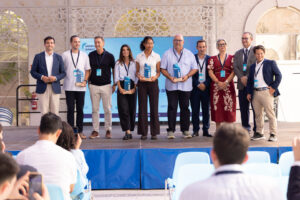
“These awards seek to give visibility to initiatives that propose new ways of relating to the sea. Many projects begin with an idea and need spaces where they can showcase it, test it and connect with an ecosystem that allows them to continue moving forward,” said Yago Sierras.
The jury consisted of Pablo Tortosa, CFO of Mediterranean Algae; Carmen Ibáñez, Local Development Agent at Alicante City Council; and Ángel Escolano, Fundraising Manager at Citibox, and assessed the proposals according to their impact, the metrics provided and their potential for scalability and replication.
Through the combination of ocean data, applied technologies, entrepreneurship and Mediterranean cooperation, the second edition of MedBlueTech Summit provided a meeting point for organisations working to translate blue economy innovation into concrete solutions for the environmental and economic challenges facing coastal industries.
MedBlueTech Summit 2026: Ocean Data, Digital Transformation and Blue Innovation in the Mediterranean