

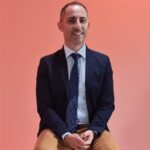

Alioune Diagne and the sea that watches us – At Blue Life Hub, we work to make society understand how urgent and demanding real change is for the future of our seas and coastal communities. We rely on data, projects and policy, but sometimes words are not enough.
Born on the coasts of Senegal and shaped by the life and daily gestures of its coastal communities, Alioune Diagne embodies a deep sensitivity to the sea and to the people who depend on it. Through fishermen, pirogues and fragile horizons, his paintings make visible the human dimension of a broken relationship with the ocean.
If our goal is to truly value and support coastal communities, their stories must be seen as well as told. Alioune’s art makes this possible.
The voice of Alioune Diagne:
For over ten years, I have been painting scenes of everyday life inspired by my country of origin, as well as by encounters made during my travels in Europe, where I lived for several years, and in the United States, where I have worked on artistic projects.
These scenes allow me to make visible the realities of my country and of the African diaspora around the world, while exploring issues that I consider fundamental today: the place of women in society, coexistence, discrimination, the plundering of Africa’s resources, growing pollution, and questions of exile and migration.
A story of environmental crisis, survival and migration:
These social impacts go hand in hand with a severe environmental crisis, marked by the destruction of ecosystems, pollution of waters and coastlines, the degradation of sandy soils, and the depletion of species and their habitats.
I became even more aware of the scale of this issue in 2022, when I travelled across Senegal along the Senegal River as part of a project on water commissioned by the Musée des Beaux-Arts de Rouen, which resulted in an exhibition. In the village of Guet Ndar, in Saint-Louis, I met fishermen facing an untenable reality: some become migrant smugglers in order to survive, others attempt the crossing to Europe at the risk of their lives, while many expose themselves to extremely dangerous conditions in pursuit of the last remaining catches.

Acrylic on canvas, 180 x 250 cm
These encounters deeply shaped my reflection on the links between resource exploitation, survival, environmental fragility and clandestine migration, and gave rise to several projects centred on the question of exile. This reflection has unfolded across different exhibitions, notably Seede (Testimony in Wolof), presented at Galerie Templon in Paris, an exhibition focused on migrant narratives and on the depiction of perilous sea rescues involving boats filled with men and women attempting exile.
This is an issue I confront very directly, as I now live on the Petite Côte in Senegal, where fishermen and residents, particularly due to fish scarcity, attempt exile across the Mediterranean at the risk of their lives. The tragedies that result from this regularly dominate the news and affect me deeply.
In 2024, this theme was also at the heart of my project for the Senegal Pavilion at the Venice Biennale, through a monumental work juxtaposing scenes that illustrate major contemporary issues, including the plundering of Africa’s resources and the clandestine migration that follows.
More recently, I had the honour of being awarded the Talents Contemporains prize from the Fondation Schneider, a contemporary art centre dedicated to the theme of water, for a work that is particularly close to my heart: Géeju neefare – Plastic Sea. This work depicts a family in a pirogue, surrounded by empty boats and plastic waste. It evokes pollution, the scarcity of marine resources that prevents fishermen from working, and the exile of entire families. I chose to introduce a luminous horizon and the presence of a child in order to convey a sense of hope.

Oil on canvas, 145 × 180 cm. © EDELINE
Pirogues, solidarity, environmental crisis and artistic language
In my work, I often depict simple scenes of life that nonetheless convey these complex realities: unsuccessful fishing returns with empty nets and motionless pirogues, sea rescue scenes, women waiting for fishermen to return. The motif of the pirogue is very present in my work, embodying this dual dimension of fishing and exile. As in Géeju neefare – Plastic Sea, I also try to introduce a note of hope, for example by portraying acts of rescue and solidarity among fishermen.
My artistic language, which I describe as figuro-abstro and which I developed following my
training at the École des Beaux-Arts in Dakar, consists of composing scenes from a multitude of
small abstract signs drawn in an automatic manner. This style, situated between abstraction and
figuration, requires a process of deciphering on the part of the viewer, producing a gradual
revelation as the scene emerges. For me, this is a way of fostering awareness around these crucial
issues.

For example, in MBAAL – Fishing Net, a work presented at the former Palace of Justice in Dakar
as part of the 2022 Dakar Biennale, I depicted a man standing apart from a crowd of figures
observing a fishing net covering the entire background of the canvas. Only gradually does the
viewer realise that the abstract forms caught in the net are not fish, but plastic waste discarded by
foreign fleets, creating an effect of revelation. It is through this type of scene that I address these
sensitive realities affecting our coastlines and local populations, seeking to share them with as
wide an audience as possible.
Discover all his works at: Alioune Diagne Instagram
Alioune Diagne and the sea that watches us