



• WHO WE ARE
  • CONTACTS
  • PARTNERS
  • ADVERTISING
  • NEWSLETTER
Thursday, November 13, 2025
BlueLifeHub
  • Home
  • News
  • Fishing
  • Aquaculture
  • Environment
  • Players
  • Innovation
  • Events
  • Integrated Activities
No Result
View All Result
Blue Life Hub
  • Home
  • News
  • Fishing
  • Aquaculture
  • Environment
  • Players
  • Innovation
  • Events
  • Integrated Activities
No Result
View All Result
Blue Life Hub
No Result
View All Result
Home Aquaculture

Aquaculture. Italian research on sea urchin feed

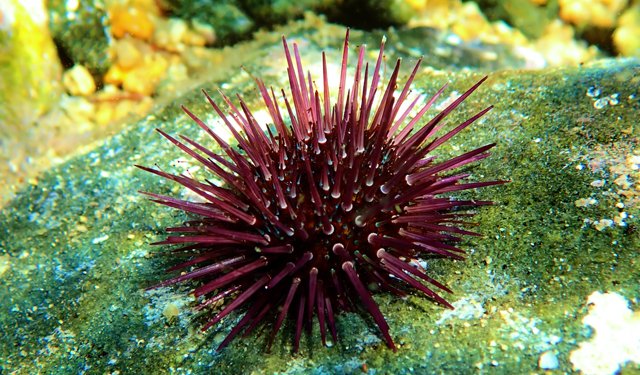
The edible part of Paracentrotus lividus, increasingly appreciated by consumers, is represented by the gonads, more commonly called roe, sea urchin roe.

Editorial staff by Editorial staff
January 12, 2023
in Aquaculture, Environment, Innovation
Reading Time: 2 mins read
0
Aquaculture. Italian research on sea urchin feed

Aquaculture. Italian research on sea urchin feed

Aquaculture. Italian research on sea urchin feed – The edible part of Paracentrotus lividus, increasingly appreciated by consumers, is represented by the gonads, more commonly called roe, sea urchin roe.

Today the exuberant demand for sea urchin roe from all over the world has caused severe pressure on wild stocks and the consequent need to develop aquaculture systems to produce enough of them. One of the major obstacles in the breeding of Paracentrotus lividus is the development of effective feed for the various life stages of the species.
It is on this need that a group of Italian scholars has conducted research, published in the Journal of Marine Science and Engineering, which aims to develop artificial feed for the post-larvae of Paracentrotus lividus, a fundamental step to improve their production capacity and post-larvae growth.

Italian researchers are working on the development of post-larval feeds

Maissa Gharbi, Francesca Glaviano, Serena Federico, Bruno Pinto, Anna Di Cosmo, Maria Costantino and Valerio Zuppo, in their study tested various natural components and preparations to accelerate growth and improve survival rates of post-larvae, taking into account abiotic and biotic factors influencing culture conditions in three replicate series of tanks, characterized by different volumes.
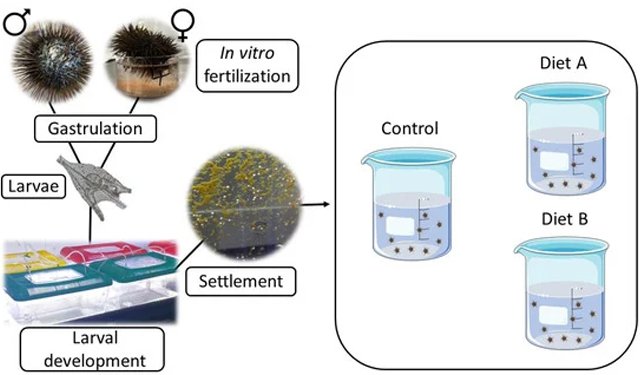
 

Experimental scheme of the feeding trial with control diet and diets A and B, starting from in vitro fertilization

Spirulina and Ulva rigid

Formulated feeds were tested and compared with the effect of fresh foods in the framework of canonical cultural practices. The results of the research indicated the efficacy of a feed composed of spirulina and Ulva rigid. Statistical analyzes demonstrated the positive impact of this diet on post-larval growth, behavior and survival rates. Furthermore, researchers demonstrated the efficacy of feeds prepared in the sea urchin aquaculture system, because they facilitated manipulation and control of culture procedures for satisfactory growth of Paracentrotus lividus post-larvae.

Aquaculture. Italian research on sea urchin feed – Here it is possible to read the study entitled Scale-Up of an Aquaculture Plant for Reproduction and Conservation of the Sea Urchin Paracentrotus lividus: Development of Post-Larval Feeds.

Tags: aquacultureblue economyblue trasnformationeuropefeedfish farmingItalysea urchin
ShareShareTweetSend
Previous Post

UN. MSC as global indicator for action on biodiversity loss

Next Post

Fishing and innovation at the center of Italian-Tunisian cooperation

Editorial staff

Editorial staff

Related Posts

How the blue crab becomes food for cats in Northern Italy

How the blue crab becomes food for cats in Northern Italy

by Orazio Albano
November 13, 2025

How the blue crab becomes food for cats in Northern Italy In the North Adriatic in Italy, where the blue...

SIPA 2025: The 10th Edition of the International Aquaculture and Fisheries Exhibition in Oran

SIPA 2025: The 10th Edition of the International Aquaculture and Fisheries Exhibition in Oran

by Douniazad Abbani
November 10, 2025

SIPA 2025: The 10th Edition of the International Aquaculture and Fisheries Exhibition in Oran From November 6 to 9, the...

An Alternative Bright Future: Chatham Harvesters’ community-supported fisheries as a model for a sustainable and equitable future

An Alternative Bright Future: Chatham Harvesters’ community-supported fisheries as a model for a sustainable and equitable future

by Fatima Abdl-Haleem
November 7, 2025

An Alternative Bright Future: Chatham Harvesters’ community-supported fisheries as a model for a sustainable and equitable future. Fisheries in the...

Aquaculture Stewardship Council: the certification opens new horizons for Africa

Aquaculture Stewardship Council: the certification opens new horizons for Africa

by Orazio Albano
November 5, 2025

Aquaculture Stewardship Council: the certification opens new horizons for Africa Aquaculture has the potential to play a central role in...

Next Post
Fishing and innovation at the center of Italian-Tunisian cooperation

Fishing and innovation at the center of Italian-Tunisian cooperation

Leave a Reply Cancel reply

Your email address will not be published. Required fields are marked *

Categories


Newsletter

Blue Life Hub

The goal of Blue Life Hub is to inform and network between players in the Mediterranean and Africa, areas that have very important commonalities and shared interests.

Categories

  • Fishing
  • Aquaculture
  • Environment
  • Players
  • Innovation
  • Events

Follow us on:

Stock images by Depositphotos

  • WHO WE ARE
  • CONTACTS
  • PARTNERS
  • ADVERTISING
  • NEWSLETTER

© 2025 BLUE LIFE HUB. - P.Iva: 06325260823

Welcome Back!

Login to your account below

Forgotten Password?

Retrieve your password

Please enter your username or email address to reset your password.

Log In

Add New Playlist

No Result
View All Result
  • Home
  • News
  • Fishing
  • Aquaculture
  • Environment
  • Players
  • Innovation
  • Events
  • Integrated Activities
  • Who We Are
  • Contacts
  • Partners
  • Advertising
  • Newsletter

© 2025 BLUE LIFE HUB. - P.Iva: 06325260823