


Maghreb marine science summit in Nouakchott: a region confronts climate pressure and turns to the blue economy
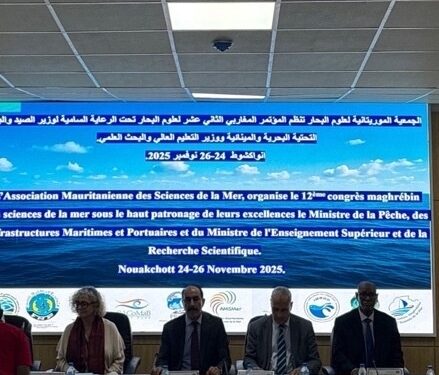
For three days, Nouakchott became a meeting point for marine scientists from across the Maghreb and beyond, as Mauritania hosted the 12th Maghreb Congress of Marine Sciences. Organized by the Mauritanian Association for Marine Sciences under the supervision of the Ministry of Fisheries, the event brought together researchers, policy-makers, and international institutions to confront the environmental pressures shaping the future of the region’s seas.
Opening the congress, the Secretary General of the Mauritanian Ministry of Fisheries underlined the “delicate moment” in which the meeting is taking place—one marked by accelerating climate impacts, stressed fish stocks, and rising marine pollution. He emphasized that sustainable development is now a matter of necessity, not choice, and that protecting marine resources is central to food security and economic stability in the region.
He also highlighted the urgency of strengthening Maghreb scientific cooperation, calling it the only way to build a strong knowledge network capable of transforming environmental challenges into opportunities for a resilient blue economy.
A rich scientific program spanning climate, biodiversity, pollution, and fisheries
Day 1 — biodiversity, climate change & marine microbiology
The congress opened with a keynote on the cross-border framework for managing the blue crab invasion in the Mediterranean, a species whose rapid spread has disrupted ecosystems and local fisheries.Throughout the day, researchers presented studies on:
Sea turtle nesting in Senegal,
Fish biodiversity in mining areas,
Genetic tools for classifying leech species in Tunisia.
The afternoon shifted toward microbiology and public health, with discussions on fish product hygiene, the incidence of Helicobacter pylori in seafood, and assessments of water quality in Tunisian oases.
Day 2 — pollution, ecotoxicology & pressures on fisheries
Pollution took center stage on the second day, with research exploring the toxicity of pesticides, industrial discharge, and pharmaceutical residues on marine organisms.
A major focus was the pervasive spread of microplastics. Studies highlighted:
Contamination levels in Mauritanian marine protected areas,
Microplastic presence in local fish species,
Seasonal changes in microplastic distribution along the Nouakchott coast.
The fisheries sessions featured insights into lobster exploitation in Dakhla, along with an important social study on the invisible role of women in small-scale fisheries value chains in Senegal.
Day 3 — ocean dynamics, habitat change & ichthyology
The final day turned to large-scale ocean processes and their ecological impacts. Presentations included:
Ocean acidification patterns along the eastern Atlantic,
Coastal environmental changes on Djerba Island,
How oxygen-minimum zones and upwelling variability are affecting Mauritanian waters.
The congress concluded with a set of ichthyology studies covering habitat mapping, reproductive biology, feeding ecology, and community-based monitoring initiatives led by citizen scientists in Libya.
Towards a stronger Maghreb marine research community
Beyond the data and scientific sessions, the congress delivered a clear message: Maghreb countries face the same environmental challenges—and they stand to gain far more by tackling them together. From climate-driven ecosystem shifts to the spread of invasive species and mounting pollution, the region’s seas are interconnected, and so must be the research efforts.
By hosting this edition, Mauritania reinforced its position as a regional hub for oceanographic and fisheries research, supported by the long-standing work of the Mauritanian Institute for Oceanographic and Fisheries Research.
Maghreb marine science summit in Nouakchott: a region confronts climate pressure and turns to the blue economy